
I can't watch the whole speech.
I put my hand over my eyes and peek out between my fingers, the way I did as a child during the scary part of a movie.
I take him in small bites. A clip here. A headline there. My stomach tightens before my mind catches up to why.
There is a dog in me that growls low before she decides whether to leap into the arena. Not reactive. Watchful. Something has to earn the leap.
This week, something did.
The growl is not the leap.
I have learned, slowly, that anger without precision is just noise added to noise. The world has enough noise. What it needs is someone willing to name the thing exactly—not louder, but clearer.
So I ask myself: what, precisely, happened?
History teaches that there are moments when ordinary politics begins to resemble something more dangerous. I do not make such comparisons lightly. There are forms of power that ask us to stop seeing one another clearly, to surrender truth for loyalty, neighbor for tribe, conscience for belonging.
But such power never acts alone.
Around it, throughout history, gathers a court—not only of the deceived, but also of the willing.
Some are Icarus, drawn toward a brightness they mistake for warmth.
Others seem to have found, in that same heat, a place to aim something old and wounded outward.
There is a difference.
One can still be reached through conversation.
The other requires accountability.
Both orbit the same sun.
What they destroy on the way down does not remain contained to them.
Somewhere in the small bites, in the peeking through my fingers, the anger gives way to something else. My eyes fill before I understand why.
I did not expect tears.
But grief, I am learning, is what anger looks like when it finally slows down enough to remember what it loves.
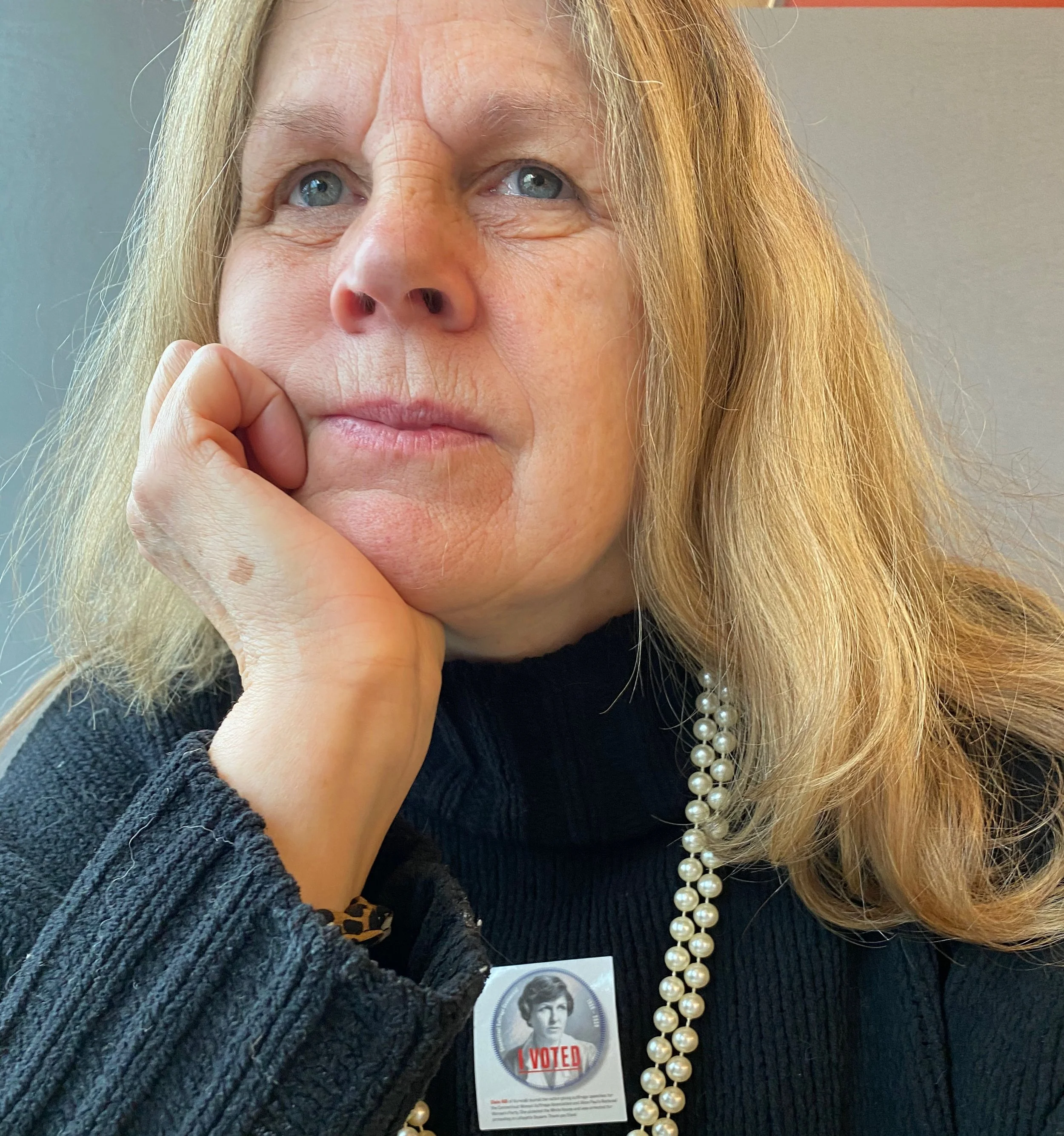
My father checked the voting machines.
My mother greeted the voters.
Small-town Connecticut. Decades of Novembers. The two of them moving through this modest, unglamorous choreography as if it mattered—because it did.
He was born in 1923. She in 1925.
Depression children. Then a world at war.
They knew what scarcity cost, and what it meant to be asked to do your part—not for recognition, but because the doing itself mattered.
I didn't have words then for what I was watching.
I have them now.
What I was watching was devotion.
Ordinary, unglamorous, unbroken devotion to something larger than any one household. A devotion built by hand, seal by seal, neighbor by neighbor.
This is what I fear we are dismantling.
Not an abstraction.
This.
When I find myself drifting toward despair, two companions steady me.
Howard Thurman wrote of the "hounds of hell" that pursue us—fear, deception, hatred—not so we would despair, but so we might see clearly enough to resist them without becoming them.
Vincent Harding spent a lifetime walking what he called the river of the freedom movement. Even in the face of profound injustice, he refused to let the struggle curdle into contempt. He held open the possibility that courage and love could coexist with truth-telling.
I need them both right now.
Thurman helps me name what is chasing us without flinching.
Harding reminds me that if I lose my capacity for human dignity—even toward those with whom I profoundly disagree—I will have surrendered something essential before the struggle is over.
Because what is at stake is not only an election.
Or a speech.
Or a single man.
It is whether devotion like my parents' still means anything at all.
And that is not merely a private grief.
It is a civic one.
There is a kind of action that gathers in the streets, and I believe in it. I have believed in it since I was a teenager joining a generation insisting, out loud, that this country live up to what it claimed to be. That was never about tearing down. It was about holding up a mirror and refusing to look away.
But marching is not the only form devotion takes.
This winter, after a controversial federal operation in Minnesota that resulted in a woman's death, the response was not only grief in the streets. It was lawyers documenting harm, cities joining together, and a state attorney general using the courts to challenge what had happened. Protest mattered. So did painstaking legal work. Democracy has many tools when we choose to use them.
Perhaps devotion begins not with changing the whole country, but by asking what is ours to tend.
Do you know who administers elections where you live—and have you ever thanked them?
Have you taken the time to learn how your state's election system actually works before repeating a claim that it is rigged?
Is there a local election official on this year's ballot whose work quietly shapes public trust?
Have you supported the organizations already doing the patient legal work of protecting constitutional rights and fair elections?
Who, in your own community, quietly holds democracy together—your town clerk, librarians, teachers, local journalists, volunteers—and how might you encourage them to keep going?
And when the loudest voice in the room insists the whole system is broken, will you pause long enough to ask:
Broken for whom?
According to whom?
Toward what end?
The hounds are real.
I do not doubt that.
But so is the river.
It flows through people who still show up before the coffee is poured, who check the seal, greet the voter, file the lawsuit, count the ballot, tell the truth, and refuse to surrender either clarity or compassion.
I am choosing to believe that this quiet devotion is stronger than spectacle.
Not blindly.
On purpose.