
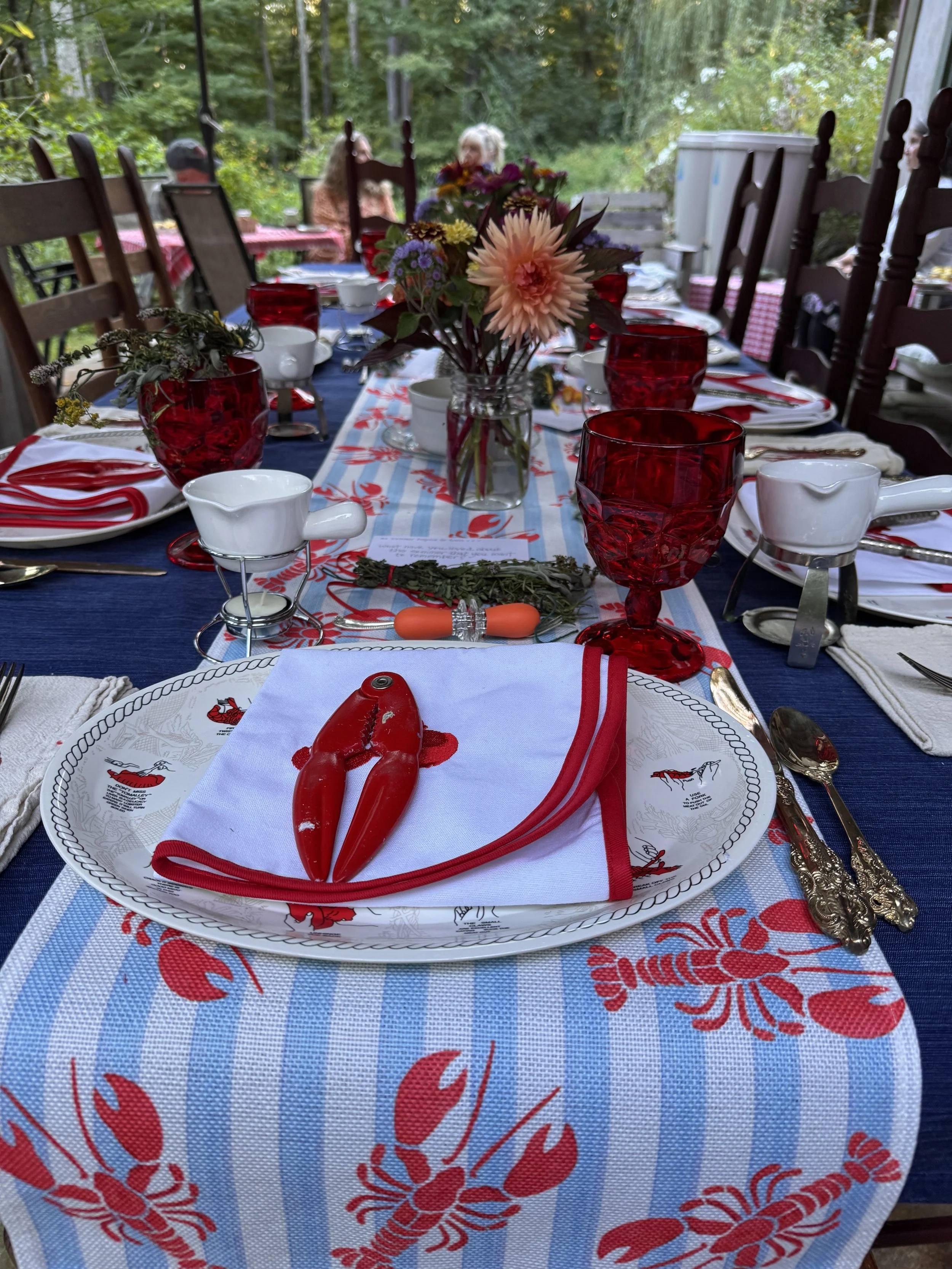
The morning after our annual lobster dinner, I finally sat down.
The dishes had been washed. The borrowed pots and propane burners had made their way home. The tables had been cleared, the leftovers tucked away. I put my feet up on the chaise lounge to rest in the same beautiful summer space where, the evening before, friends had gathered around long tables to eat lobster, corn and potatoes, raise a toast with champagne, tell stories, and celebrate another year together.
And in the quiet after all that activity, I began to think about the lobster.
Which is interesting, because I had managed rather successfully not to think too deeply about it before.
Not entirely. There had been nudges.
There is something about cooking a live lobster that can feel almost unbearably cruel. I had wondered about the most humane way to do it. I had read conflicting opinions. And underneath that was a larger discomfort about the inhumane treatment of animals, and the quiet disconnection of buying meat without ever honoring the life it came from.
I know enough about industrial food production, factory farming, fishing practices and the ecological pressures on our oceans to know there are questions worth asking. Over the years I have made changes because of what I have learned. I primarily buy locally. I don't grow my own food, I go to a local farm stand, a farmers market, a food co-op. I avoid many disposable plastics. I reuse, repurpose, thrift, compost and pay attention.
And I also compartmentalize.
I suspect many of us do.
There are things we know, things we half know, things we don't know, and things we have an uncomfortable inkling about but tuck gently—or not so gently—off to the side.
With the lobster dinner, I apparently had a Scarlett O'Hara moment:
I'll think about that tomorrow.
Because there was something else sitting on the other side of the scale.
Tradition.
Lobster has always meant summer to me — evenings as a child watching my father haul lobster from his own pot, the particular kind of togetherness that gathering around a table of cracked shells and melted butter seems to invite. Years later, as an adult, that thread found its way back to me through this particular group of friends, who first invited me into their August birthday lobster boil. It became a way of linking my past to a newer tradition of friendship.
This wasn't simply a menu choice.
It was memory. Friendship. Family. Place. Belonging.
And this year, for the first time, we were hosting.
So I went about the considerable business of having people for dinner.
The Village Around the Table
A phrase kept arising as we prepared for the gathering:
It takes a village.
And it did.
One family brought the propane burners and enormous pots needed for the boil. Someone else brought lobster crackers and picks and little butter warmers. People arrived with appetizers and side dishes, potatoes and vegetables from gardens, and corn grown at a farm nearby.
Some of the serving pieces had been purchased secondhand. Others had traveled from one lobster dinner to another for years. Even some of the plastic pieces I might ordinarily dismiss were not disposable things at all, but durable objects brought out year after year.
It was potluck in the oldest and loveliest sense of the word.
No one person needed to own everything.
We shared what we had.
And yet, in the midst of all this convivial cooperation, there was a moment I am less proud of.
Somehow a simple remark about my cloth napkins I blurted out something along the lines of:
"I would never. I hate plastic. I refuse to use plastic."
It came out with far more righteousness than the moment deserved.
I heard myself.
Later I hugged my friend and apologized.
But I have been thinking about that moment, too.
Why did I need to proclaim my environmental virtue quite so loudly?
Perhaps because it gave me, for a moment, somewhere firm to stand.
When Caring Becomes a Pressure Cooker
It is difficult to care about the ecological world right now without sometimes feeling overwhelmed.
Climate change. Plastics. Industrial agriculture. Polluted water. Species loss. The warming of the oceans. Fishing practices. Food safety. The eroding environmental and public-health protections we depend upon. Government policies that can strengthen those protections—or dismantle them.
Then there are the hundreds of decisions an ordinary person makes.
What fish should I buy?
Where did this meat come from?
Are these vegetables local?
Organic?
What is this packaged in?
Can it be recycled?
Who made this?
Under what conditions?
How far did it travel?
Can I afford the better choice?
Do I even know what the better choice is?
It can become a pressure cooker of impossible ethical perfection.
And perhaps one of the ways that pressure escapes is through judgment.
I would never use that.
I only buy this.
How can people still do that?
For a moment we get to stand safely on the correct side of the line.
Except there I was, proudly proclaiming my refusal of plastic while preparing to eat an animal whose death, fishery and ecological impact I had deliberately chosen not to examine too closely.
That contradiction interests me.
Not because I want to serve it up as one more thing to feel ashamed of.
There is already plenty of shame available to us.
We can pile it on until ethical living becomes so perfectionistic, joyless and impossible that we either become insufferable to one another or give up altogether.
Neither seems particularly useful.
I am becoming more interested in what happens if we stay with the contradiction.
What Else Is Sitting at the Table?
Perhaps every meal contains more participants than we can see.
There was the lobster.
There was the ocean from which it came and the people whose livelihoods depend upon that water.
There was the corn, grown just down the road, and the soil and rain that produced it.
There were gardens.
Fuel.
Packaging.
Labor.
There were regulations and inspection systems most of us rarely think about until something goes terribly wrong.
There was money, too.
Who can afford to make particular choices? Who has access to local farms or farmers markets? Who has the time to investigate how a fish was caught or where a vegetable was grown?
And there were my friends.
There was laughter and generosity and history.
There was the deeply human practice of feeding one another.
These matter, too.
I don't want an ecological ethic that requires us to regard every pleasure with suspicion.
Nor do I want one that allows pleasure, habit or tradition to keep us permanently from asking uncomfortable questions.
Perhaps the practice lies somewhere between those two.
Beyond the Shopping Cart
We have been taught to think of environmental responsibility largely as a collection of individual choices.
Recycle.
Bring your own bag.
Avoid plastic.
Buy local.
Choose sustainable seafood.
Drive less.
Those choices matter. I intend to keep making them and, I hope, keep improving them.
But there is something peculiar about placing the enormous burden of planetary sustainability onto the individual standing in a grocery aisle trying to decide what to make for dinner.
I can investigate where my lobster comes from.
I cannot personally regulate a fishery.
I can choose vegetables from a local farmer.
I cannot personally inspect the nation's food supply.
I can reduce the plastic coming into my house.
I cannot determine what corporations manufacture, what industries discharge into our water, what environmental protections are enforced, or what safeguards governments decide to remove.
Those require something else from us.
Citizenship.
Public policy.
Regulation.
Collective action.
Voting.
Community.
Perhaps ecological responsibility also takes a village.
That doesn't release me from examining my own choices. If anything, it places them within a larger and more honest landscape.
There are things I can change at my own table.
There are other things none of us can change alone.
Wisdom may lie partly in learning the difference—and participating in both.
The Morning After
Which brings me back to the chaise lounge outside.
The party was over. The decision had already been made. The lobsters had been eaten.
Nothing could be undone.
And perhaps because of that, something in me finally relaxed enough to become curious.
Instead of asking, How could you have done this?, another question became possible:
What would I like to understand before we do this again?
Where should we buy the lobster?
How are the lobsters caught?
What fisheries are healthy and well managed?
What does warming ocean water mean for this tradition?
Is there a more humane way to prepare them?
Who is responsible for protecting these waters—and are they doing it well?
Could my friends and I find a way to ask these questions together, without losing what makes the evening ours?
Maybe next year's lobster dinner will look exactly the same.
Maybe it won't.
I don't know yet.
But I know more questions now.
And I am beginning to think this is one way consciousness grows.
We notice.
We become curious.
We learn what we can.
We allow what we learn to trouble us a little.
We make a different choice where we can.
Sometimes we discover that our individual choice is not enough, and we join with others to protect something larger.
And then we pay attention again.
Ethical grounding is not ethical purity.
It is not somehow managing to make every choice correctly before we have made it.
It may be something much humbler.
Creating enough ground beneath ourselves that we can bear to look honestly at what our lives participate in—without immediately fleeing into denial, shame or righteousness.
And then remaining there long enough to ask:
Knowing what I know now, what might I choose next?