“The real voyage of discovery consists not in seeking new landscapes,
but in having new eyes.”
There are moments in life when something shifts—not because the world has changed, but because our way of seeing has.
A friend points something out.
A book unsettles us.
A work of scholarship opens a window we didn't know existed.
And suddenly, what once seemed ordinary becomes impossible to overlook. Once seen, it cannot entirely be unseen.
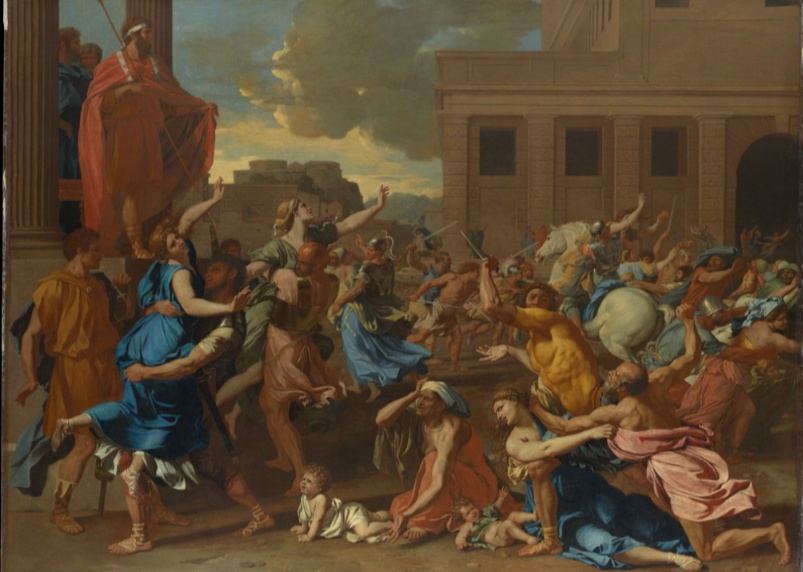
I've been thinking about this after learning about the work of writer, curator, and researcher Macushla Robinson, whose exploration of Western art asks a deceptively simple question.
For generations, students have stood before some of the world's most celebrated paintings learning to admire the artist's mastery of light, composition, symbolism, and technique. These are worthy questions. They deepen our appreciation for beauty and artistic achievement.
But Robinson asks us to notice something else.
Many of these same masterpieces depict scenes of abduction, coercion, or sexual violence against women—stories often drawn from mythology or scripture, yet generations of students were rarely invited to examine these realities alongside the paintings' artistic brilliance.
The paintings themselves have not changed.
Our attention has.
That distinction feels important.
Because this isn't ultimately an essay about art history.
It is an essay about consciousness.
Every culture teaches us where to place our attention.
Every culture also teaches us, often without realizing it, what can remain comfortably in the background.
Not necessarily through malice.
More often through inheritance.
Through repetition.
Through familiarity.
We learn what deserves our attention long before we learn how to question it.
As a nurse, I witnessed something similar every day.
Two people could stand beside the same hospital bed and notice entirely different things.
A physician might focus on laboratory values.
A specialist on diagnosis.
A nurse often notices something else.
The spouse who has quietly stopped sleeping.
The subtle fear in a patient's eyes.
The family conversation that isn't happening.
None of these observations cancel the others.
They simply widen the field of perception.
Perhaps this is one of the deepest invitations of Ethical Grounding.
Not replacing one story with another.
Expanding our capacity to hold more of reality.
That expansion is rarely comfortable.
Because seeing more often brings grief.
When we begin recognizing patterns of domination—whether in the treatment of women, Indigenous peoples, Black communities, the living Earth, or even within our own families—we may experience a profound sadness.
Not because these realities are new.
But because we are seeing them with new eyes.
The temptation at that moment is understandable.
To defend.
To deny.
To become overwhelmed.
Or to turn our attention elsewhere.
Yet another possibility exists.
Curiosity.
Not curiosity that minimizes harm.
Curiosity that asks:
How did this become normal?
What assumptions shaped what previous generations learned to see—and what they learned not to see?
Whose experience has remained just outside the frame?
These are not questions of blame.
They are questions of consciousness.
Culture rarely changes because someone wins an argument.
More often, it changes because enough people begin to recognize a pattern they could not previously name. Once named, it becomes increasingly difficult to accept as inevitable.
As I've sat with these questions, I've realized something both humbling and hopeful.
The older I become, the less interested I am in deciding who is awake and who is asleep.
Instead, I find myself asking:
What am I only now beginning to see?
I've spent much of my life cultivating awareness through nursing, mindfulness, and my relationship with the living world. Yet I continue to discover places where my own vision has been quietly shaped by the culture into which I was born—places where I inherited assumptions without consciously choosing them.
That realization doesn't fill me with shame.
It fills me with humility.
Because awakening is not a single event.
It is a lifelong practice.
Again and again, life invites us to widen our field of attention.
To see a little more.
To love a little more.
To participate a little more fully in the healing of the world we share.
This, I believe, is the quiet work of Ethical Grounding.
Not standing outside our culture in judgment.
Not replacing one certainty with another.
But becoming steady enough to widen our field of attention until more of reality can be held together.
To appreciate beauty while also asking what stories beauty has sometimes concealed.
To admire brilliance while remaining awake to suffering.
To hold grief without surrendering hope.
Perhaps this is what Vincent Harding meant when he spoke of participating in "the ongoing creation of a more just and loving world."
Not standing safely on the riverbank, commenting on the current.
But stepping into the river itself.
Knowing we will continue to learn.
Knowing we will sometimes stumble.
Knowing our vision will continue to expand.
And trusting that this, too, is part of becoming fully human.