
A few weeks ago, during the gloaming hour, I went outside with my beloved companion Hattie for her last walk before bed.
I love this time of day, as things wind down and the light holds a gentle threshold between day and night. I often pause, close my eyes, and take a deep breath, awakening my senses to what is alive within and around me. The familiarity of one’s home and yard offers a calm sense of security that often allows perception to soften and deepen.
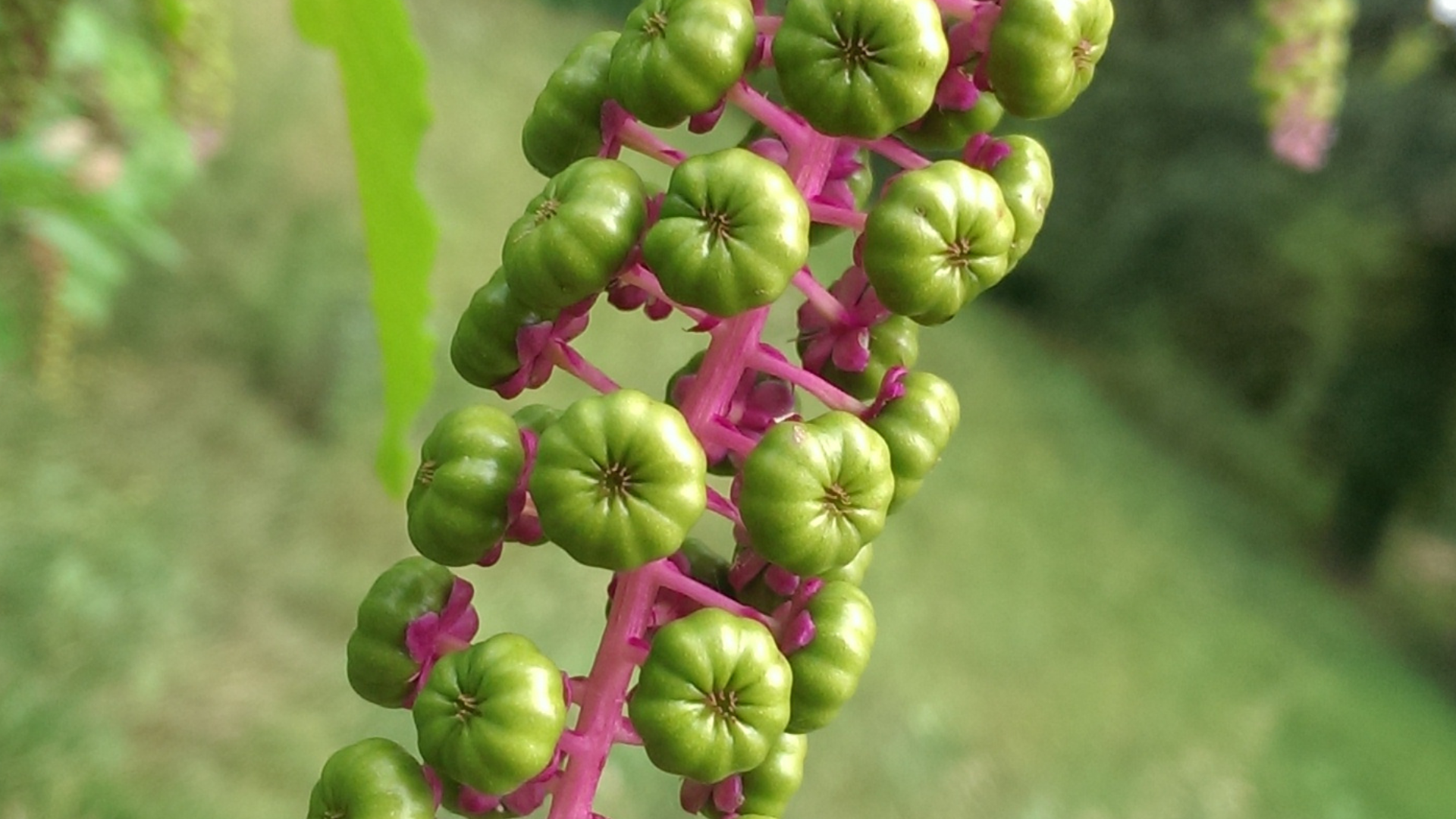
On this evening, as I walked barefoot up the two steps into the side yard, I passed between the witch hazel tree and the overgrown pokeweed flanking the steps. I stopped and reached toward the small pokeweed flower heads, still held tightly in bud.
I touched them.
It was such a small, spontaneous, almost unconscious gesture, yet it caught my attention.
There was tenderness in my hand.
I wasn’t examining the plant or trying to identify it. I wasn’t intentionally practicing mindfulness or gratitude. I simply reached toward it with affection—the way I might reach out to touch my granddaughter’s hair or place my hand gently on someone I love.
The deep felt sense of affection and interaction moved me.
As I continued into the yard, a gentle breeze moved through the leaves and caught my attention. I looked up to greet the sugar maple, the swaying tops of the pines, the bare gray limbs of the ash standing tall among the living trees.
For a moment they felt extraordinarily close.
Not metaphorically close.
Intimately close.
And almost simultaneously, I felt something else.
Loneliness.
There seemed to be a veil between us.
I could feel my affection moving toward this living world, but I couldn’t know whether anything was moving toward me.
Do you know I’m here?
Do you experience me in some way?
Is this communion something we are participating in together, or is the experience entirely mine?
I have spent much of my life comfortable with mystery. Dreams, synchronicities, encounters with animals, moments in the natural world that seem charged with meaning—these have long been part of the way I experience life.
When I was younger, I may have been more willing to call some of this magic.
As I’ve grown older, I have become more discerning about what I claim to know.
I value that discernment.
But sometimes I miss the magic.
I don’t want maturity to require disenchantment.
And so I stood beneath the trees with both things alive in me: a profound sense of communion and the impossibility of knowing exactly what that communion is.
THE BUBBLE
These experiences are often brief.
They arrive with surprising distinctness—a moment when the ordinary world seems to become translucent and something more intimate is present.
Then it is gone.
I’ve begun thinking of them as bubbles.
A bubble is real. Its edges are distinct. Light catches its surface. For a moment it exists completely.
But try to grasp it and it disappears.
There is something in me that wants to grasp these moments.
What was that?
Was it real?
How do I get back there?
But perhaps grasping misunderstands the nature of the encounter.
Some experiences cannot be possessed.
They can only be attended while they are here.
THE LONGING ITSELF
What surprised me that evening was the grief.
The closeness of the trees didn’t eliminate separation. Somehow it made the separation more palpable.
It reminded me of losing someone I love—of sensing that relationship continues in me while no longer being able to reach across and receive the familiar response.
There was something almost erotic in this.
Not sexuality in its narrow meaning, but eros as the movement of attraction—the longing to draw near to what is beautiful and beloved.
My hand moves toward the bud.
My eyes move toward the trees.
My heart moves toward the living world.
Closer.
And yet the beloved remains other.
I am part of this living Earth.
And I am also myself.
The tree is kin, and the tree is not me.
I can touch its bark, sit beneath its branches, learn its seasons, protect its roots.
And still I cannot enter completely into the mystery of its being.
There is intimacy.
And there is a veil.
YOU ARE SEEN
I have long appreciated the writing of Asia Suler, an herbalist, writer, and earth intuitive whose work is grounded in an animistic relationship with the natural world.
She often speaks with a certainty I find both beautiful and provocative.
In an essay called You Are Seen, she turns the usual practice of nature observation around. We spend so much effort learning to see the natural world, she suggests, that we may forget the possibility that we, too, are being noticed—that our presence participates in the life around us.
Something in me responds immediately:
Yes.
And another part asks:
But how do we know?
I have come to appreciate both voices.
I can walk through the woods asking not only, What do I see?
But:
What changes when I allow myself to imagine that I am also seen?
AN UNEXPECTED DOORWAY INTO THE PSALMS
As I sat with all of this, the Psalms unexpectedly entered the conversation.
I have never thought of the Psalms as particularly central to my spiritual life.
Yet suddenly I heard them differently.
So many of them are songs of turning toward something that cannot be completely grasped.
They contain praise and gratitude, but also loneliness, bewilderment, lament, and longing.
Where are you?
Do you hear me?
I seek you.
What moved me was the realization that longing itself need not be a failure of relationship.
Longing may be part of the relationship.
Perhaps communion isn’t the absence of the veil.
Perhaps communion includes our longing across it.
The psalmist keeps turning toward.
Not because every question has been answered.
Because relationship matters enough to continue.
LANTERNS IN THE DARK
I realize now that I have been teaching something I am still learning.
To live the questions is to stay present to the mystery — not to answer it, but to let it keep asking something of me
My memoir has long carried the working title Lanterns in the Dark.
Lately, I have begun to understand that title differently.
A lantern does not abolish darkness.
It gives us enough light to enter it.
Not proof.
Not an explanation for every synchronicity.
Not certainty about what consciousness lives in a tree, what happens after death, or whether the natural world experiences my affection as I experience its presence.
Enough light to remain in relationship.
Enough light to keep loving.
Enough light to walk another few steps into mystery.
THE VEIL I ALREADY KNEW
In the weeks since that evening, I have come to understand that perhaps I recognized the veil because I had encountered it before.
When my mother died, I came to know the particular ache of loving someone I could no longer reach in the ordinary ways.
Love remained.
What disappeared was the familiar certainty of response.
Like so many who have lost someone beloved, I longed for unmistakable communication—for some clear assurance that the relationship continued across whatever threshold death had created.
Dreams, synchronicities, moments of felt presence and ways of knowing that I might once have held with greater certainty have offered comfort and meaning. I don’t need to disavow those experiences now. They remain precious to me.
But perhaps I no longer need to ask them to relieve me of all uncertainty.
Because underneath the desire to know is something profoundly human.
We love.
And because we love, separation hurts.
The veil I encountered beneath the trees is not only between myself and the more-than-human world. It runs through human life itself.
To love another human being is to enter into something exquisitely precious and ultimately impermanent.
We will lose one another.
We will grieve.
And still, I want to love this life.
Perhaps more than ever.
For many years as a nurse, I have accompanied people near the threshold of death. I have witnessed families gather, bodies change, breaths become fewer and farther between. I have attended birth as well—the mysterious passage in the other direction, a human life arriving from somewhere beyond our knowing.
Birth and death have taught me something about thresholds.
They are real.
They change us.
And they retain their mystery.
There was a time when the uncertainty of my own death could awaken panic in me. Perhaps some part of my search for certainty grew from that frightened place—the wish to know that when the familiar world disappeared, something or someone would still be there.
I hold that younger self tenderly.
But something is changing.
I am less interested now in constructing certainty about what lies beyond death than in cultivating the capacity to meet this life fully while I am here.
To become capable of staying present.
To love without requiring permanence.
To remain awake to beauty precisely because it is fleeting.
And someday, when my own passage approaches, I hope I will have practiced this enough to recognize the threshold.
Not without fear, perhaps.
Not without sorrow.
But awake.
Loving.
Present.
And with Grace beside me.
Not grace as an answer.
Grace as accompaniment.
A hand, perhaps, at the veil.
TURNING TOWARD
And so I return to that evening.
Bare feet on the earth.
Hattie nearby.
My hand reaching almost unconsciously toward the unopened pokeweed flowers.
The breeze moving through the sugar maple and the pines.
The bare ash standing among the living.
I still don’t know whether the trees hear me.
I don’t know what happened in that brief moment when I touched the buds and felt such tenderness.
And I don’t want to make claims beyond what I know.
But neither do I want to explain away what I experience.
Something happens when I enter the woods attentively.
My body softens.
Affection arises.
Sometimes gratitude comes.
Sometimes grief.
Sometimes an almost aching desire to be closer.
Perhaps this is prayer.
Prayer as a way of turning toward.
A way of saying:
I am here.
I love you.
I don’t entirely understand what this relationship is.
And I am willing to remain in the mystery.
Then I walk on.
The breeze moves through the pine.
A bird calls.
My bare feet meet the earth.
The bubble has disappeared.
The veil remains.
But so does the relationship.
And perhaps that is enough