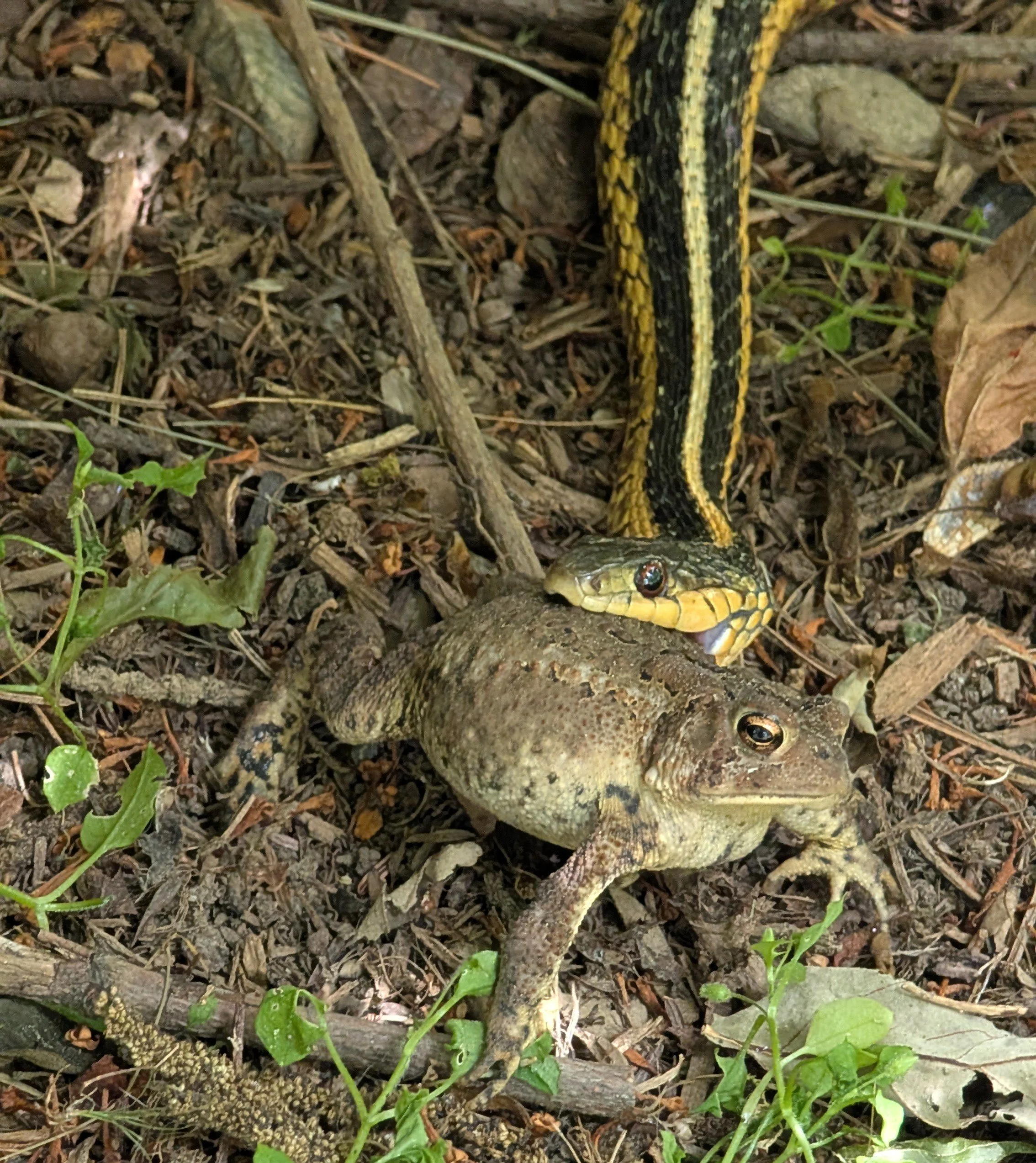
Yesterday I watched a garter snake swallow a toad.
I stayed.
Not bravely. Not with any particular clarity or purpose. I stayed the way you stay when your feet stop working and something in you recognizes, before your mind does, that this moment is asking something you are not quite ready to refuse.
The toad was alive. The snake was unhurried. Both of them, at different moments, looked at me.
I did not move.
When I shared the photographs with colleagues, the response was immediate and nearly unanimous. Save the toad. Someone recoiled from the snake. Others looked away entirely. The impulse to intervene, to rescue, to resolve the discomfort by doing something — was almost irresistible.
I understood that impulse completely.
What surprised me was that I did not feel it.
Or rather, I felt it, and something older held me still anyway. Not wisdom exactly. More like paralysis that turned, slowly, into witness.
And in that witnessing, something I did not expect began to happen.
I felt relationship form.
With the toad, yes. But also with the snake. With the whole strange, ancient, honest scene before me. Two creatures fully alive, fully present, enacting something that required nothing from me — not my approval, not my intervention, not my understanding.
Just my presence.
And something in that presence began to loosen something in me.
There is a fear I have carried since childhood.
I will not call it by its full name here, not yet, because I have spent most of my life attending to it. What I can say is that it lives in my stomach. A grip. Old and small and very far away, like something glimpsed at the edge of vision that disappears when you turn toward it.
A fear of death, specifically. Of my own ending. Of the panic that used to arrive without warning and convince me, for terrible minutes, that the ground was not solid.
I made a vow somewhere in my younger years. Quietly, privately. That I would spend my life finding peace with this.
Standing before the snake and the toad, that old grip stir.
And for the first time in a long time, I did not immediately look away.
I did not look directly either. It was more like looking through my hands. One eye open, barely. The way you approach something you are afraid might startle if you move too quickly. The way you lower yourself into cold water one foot at a time, feeling for the bottom, making sure there is ground before you shift your weight.
Howard Thurman wrote and spoke of entering the river that way. Not leaping. Not forcing. One foot, then another, staying in relationship with the water and with yourself, feeling what is solid beneath you before you go deeper.
That is what this was.
Tentative. Gentle. Almost scared.
And what I found, looking that way, sideways, carefully, through slightly parted fingers, was that the fear was smaller than I had remembered. More specific. Less like a verdict about life and more like a place in me that had simply never been truly seen.
Not because I was brave enough to look directly.
But because I stayed close enough, long enough, for it to become familiar.
That same night, images arrived from the White House lawn.
I will not describe them in detail. You likely know what I mean. A spectacle of dominance performed for cameras. Power wearing the costume of strength. Cruelty made into entertainment.
I looked away.
Quickly. One eye shut before the other one had even fully opened.
And I want to be honest about why. Because it was not simply political disagreement, not simple outrage. It was something more visceral than that. Something that registered in my body before my mind found words for it.
It felt toxic. Like a thing that was destroying, methodically and with great enthusiasm, so much of what I find precious about being alive on this planet.
I thought of Icarus. Not as metaphor exactly, but as image — power that has severed its relationship with limits, flying ecstatically toward the sun, and the rest of us watching, unable to look away entirely, unable to look directly either.
James Baldwin knew this feeling. He spent his life writing about what it costs a people, a culture, to not see clearly. To look away from what they are doing and what is being done. He knew that turning away is never innocent. It accumulates. It becomes, over generations, the very structure of the harm.
Vincent Harding, who walked beside Martin Luther King, Jr., and kept teaching long after, called the alternative the Beloved Community — not a destination but a daily practice of remaining in relationship with the full truth of where we are. Of not allowing discomfort to become complicity.
Both men also knew something else.
That you cannot force this kind of seeing. That witness without support, without relationship, without ground beneath your feet, is not courage.
It is just retraumatization.
This is what I want to say carefully, because I think it matters:
Not everything should be looked at directly. Not yet. Not alone. Not without resources. Not without someone beside you who knows how to stand in difficult water.
Thurman's river is not entered by leaping.
There is wisdom in the one-eyed look. In the hands over the face with one finger lifted. It is the body's instinct to approach slowly what has the power to undo us.
The question is not whether you can bear to see.
The question is what conditions would make it possible to see a little more than you can right now.
What ground would you need beneath your feet?
Who would you need beside you?
What would need to be true about where you are before you could take one step closer to what you’ve been turning away from?
Standing before the snake and the toad, feeling the old fear stir and then, gently, tentatively, begin to clarify, I found my own work shifting beneath me.
For years I have asked: How do I help alleviate suffering?
It is a good question. It has carried me through decades of meaningful work as a nurse, a teacher, a community member.
But something changed in that encounter.
I began asking instead: How do I help myself and others attend to the beauty of being alive?
It sounds like a subtle shift. I have come to believe it is a profound one.
Alleviating suffering positions us outside the pain, reaching in. Attending to the beauty of being alive asks us to enter more fully — to stay present to the whole of life, including its difficulty, including our fear, including the parts we approach only with one eye open.
It asks us to trust that presence itself is a form of healing.
That witness, even partial, even trembling, even through slightly parted fingers — is a form of love.
That we do not have to see everything clearly to begin.
We only have to stay close enough, long enough, for something true to become familiar.
The snake and the toad are still with me.
So is the old fear, though it sits differently now. Less like a verdict. More like a companion I am slowly learning to walk beside.
So is the grief about what is happening in the world — the Icarus energy, the spectacle, the destruction of what is precious. I have not found a way to look at it directly. I am not sure I need to yet. But I am learning to stay in the room with it a little longer than I used to.
One foot at a time.
I leave you not with answers but with the questions that have stayed with me.
Not as instructions. As invitations. To be approached, if at all, in your own time, with whatever ground and relationship and support you need beneath you.
What is the thing you have been approaching with one eye closed?
Not because you are weak. But because you are human, and some things require us to draw close slowly.
What conditions would help you take even one small step toward it?
Who would you want beside you?
And underneath the fear, underneath the turning away, underneath the grief about what is being lost in this moment in history—
What do you love?
What, when you are fully present to it, reminds you that life is astonishing and worth attending to?
That is where the work begins.
Not in the direct gaze.
In the slow, faithful, one-foot-at-a-time movement toward what is true.